

Protecting Your Future: A Guide to Divorce and Child Custody in Carrollton, GA
When you drive past the Square in downtown Carrollton, life feels steady and predictable. But inside your home, a pending divorce can make everything feel like it’s shifting beneath your feet. If you are facing a separation involving children, you aren’t just fighting for assets; you are fighting for the Saturday morning soccer games at Lakeshore Park and the right to provide a stable future for your kids.
Navigating a divorce in Carrollton, GA requires more than just filling out forms. It requires an understanding of how local judges view parental responsibilities and how the newly updated 2026 Georgia legal statutes will impact your bank account and your time with your children. Whether your split is amicable or highly contested, the decisions made today will echo for a decade or more. This guide breaks down the essential local rules of Carroll County, the recent shifts in state support calculations, and the tactical steps you need to take to protect your parental rights.

Understanding Child Custody in Carroll County
The most emotional hurdle in any West Georgia divorce is the custody arrangement. In Georgia, the North Star for every decision is the “Best Interests of the Child” standard. This isn’t a vague suggestion; it is a legal framework that judges use to evaluate which parent can provide the most stable environment.
Physical vs. Legal Custody
It is a common misconception that custody is “all or nothing.” In reality, it is split into two categories:
- Legal Custody: This relates to decision-making authority. In most Carrollton cases, parents share joint legal custody, meaning they must consult one another on major decisions regarding education, healthcare, and religious upbringing.
- Physical Custody: This defines where the child actually lives. While “50/50” schedules are becoming more common in 2026, one parent is often designated as the “primary” custodian for school enrollment purposes.
The Role of the Parenting Plan
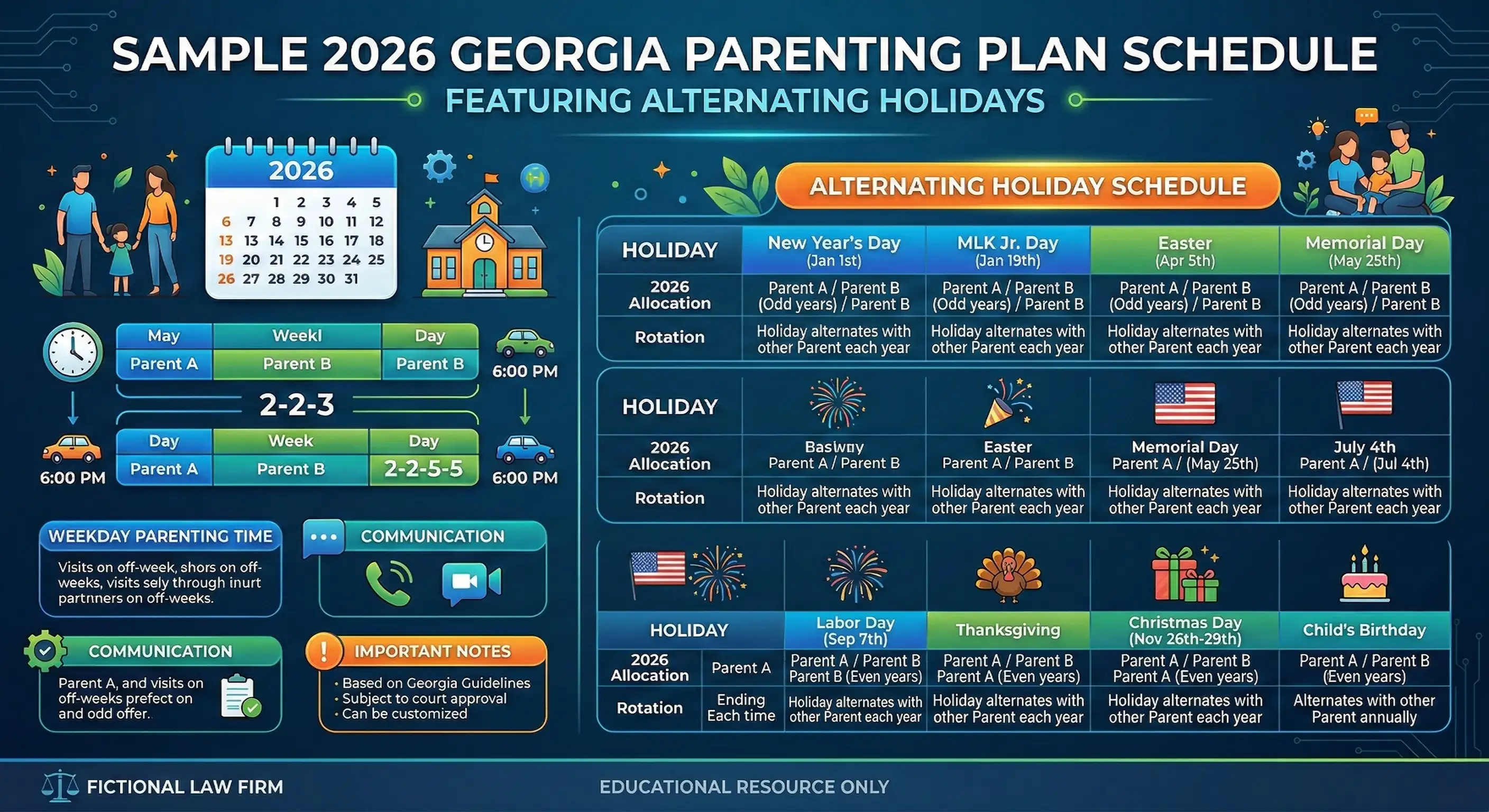
Every case in the Carroll County Superior Court requires a comprehensive Parenting Plan. This document is a roadmap for your life. It must detail exactly where the child will be for Christmas, Fall Break, and even who is responsible for transportation between homes. A vague plan is a recipe for future litigation.
Nursing Home Abuse and Neglect
Learn more about our Mediation Services to help draft your Parenting Plan.
The 2026 Georgia Child Support Calculations
As of January 1, 2026, Georgia has overhauled the way child support is calculated to better reflect the modern cost of living and the reality of shared parenting. If you haven’t looked at the guidelines recently, the old “estimates” no longer apply.
The Mandatory Parenting Time Adjustment
The biggest shift in the 2026 law is the Mandatory Parenting Time Adjustment. Previously, if a parent had significant time with the child, a judge could lower their support payment, but it wasn’t required. Now, the Georgia Child Support Worksheet automatically adjusts the obligation based on the number of overnights. This ensures that the parent providing direct care and housing for a significant portion of the month is not unfairly burdened.
Calculating “Income Shares”
Georgia uses the “Income Shares” model. This means the court looks at the combined adjusted gross income of both parents.
- Combined Income: Calculate the total monthly income of both parties.
- Basic Obligation: Match that total to the 2026 Georgia Basic Child Support Obligation table.
- Pro Rata Share: If you earn 60% of the total income, you are responsible for 60% of the basic obligation, adjusted for health insurance premiums and work-related childcare costs.
According to 2025 census data for Carroll County, the median household income has risen, making these new modernized tables essential for fair rulings.
[IMAGE: A screenshot of the 2026 Georgia Online Child Support Calculator interface.]
Georgia Child Support Commission
Navigating the Carroll County Superior Court Process
Filing for divorce in Carrollton is a localized experience. Your case will likely be heard at the Carroll County Courthouse on Newnan Street. Understanding the “home field” rules can save you months of delays.
The Standing Order and Domestic Seminars
The moment a divorce is filed in Carroll County, a Standing Order goes into effect. This legally prevents either parent from moving the children out of state or dissipating marital assets. Furthermore, Carrollton judges require all divorcing parents to attend a “Seminar for Divorcing Parents.” You cannot get a final decree without a certificate of completion from this class.
Advanced Insights: Avoiding Common Mistakes
One of the most frequent mistakes we see in West Georgia divorces is the “Social Media Trap.” In a heated custody battle, a single post on Facebook or Instagram can be used as evidence of poor judgment or hidden assets.
“In 2026, digital evidence is the ‘smoking gun’ in 70% of contested Carrollton divorces,” says a leading local family law expert. “Judges value stability and discretion. If you are venting about your ex online, you are hurting your custody case.”
Before you file, ensure you have gathered three years of tax returns, recent pay stubs, and any documentation regarding “separate property” (assets you owned before the marriage).
Pre-Divorce Financial Checklist. High-Asset Divorce in Georgia.

How much does a divorce cost in Carrollton, GA?
The cost varies wildly based on conflict. An uncontested divorce with no children might cost a few thousand dollars in legal fees. However, a contested custody battle involving private investigators or guardians ad litem can exceed $15,000. Filing fees in Carroll County are approximately $215, plus service fees.
Can a child choose which parent to live with in Georgia?
In Georgia, once a child reaches age 14, they have the right to “elect” which parent they want to live with. While the judge generally honors this choice, they can override it if they find the chosen environment is harmful or not in the child’s best interest.
How is “Standard of Living” factored into support?
The 2026 guidelines aim to maintain the child’s standard of living as if the parents were still together. This includes expenses for extracurricular activities like Carrollton High School sports or local dance classes, which are now more clearly defined in the updated support worksheets.
Do I have to go to mediation?
Yes. Carroll County typically requires parties to attend mediation through the 6th Judicial District ADR program. Most cases settle here, which is faster and less expensive than a trial. If mediation fails, only then will a judge make the final ruling on your family’s future.
What happens if my ex stops paying child support?
You can file a Motion for Contempt in Carroll County Superior Court. The court has the power to garnish wages, suspend driver’s licenses, or even order jail time for parents who willfully refuse to follow the 2026 support orders.
Conclusion: Taking the First Step
Divorce is undoubtedly one of the most stressful events you will ever face, but you don’t have to navigate the Carroll County legal system alone. From understanding the mandatory parenting time adjustments of 2026 to drafting a foolproof parenting plan, having the right strategy is the difference between a chaotic transition and a stable new beginning. Your priority is your children; our priority is ensuring the law works in their favor.
Are you ready to protect your parental rights?
- Sign up for our Monthly Family Law Newsletter
- Or contact us today for a confidential case evaluation.
What is your biggest concern regarding the new 2026 child support changes? Leave a comment below and let’s start the conversation.